


|
Quantity
|
Total
|
||
|
|
|||
|
|
|||
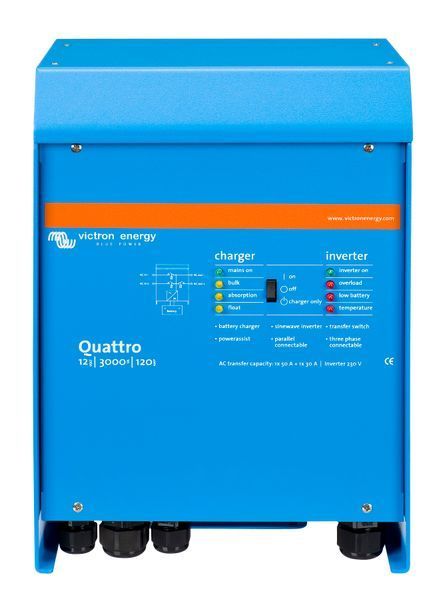
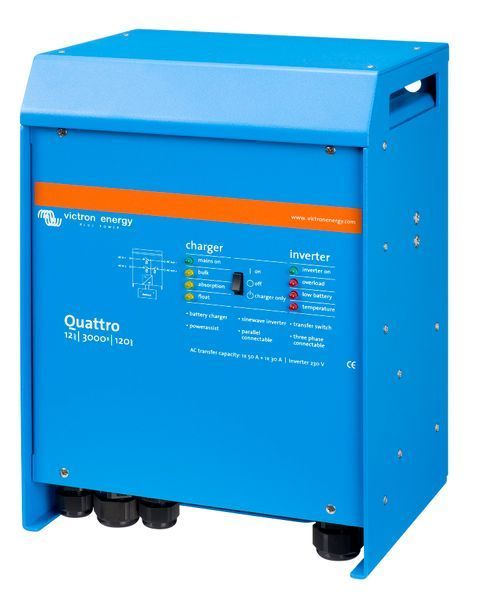
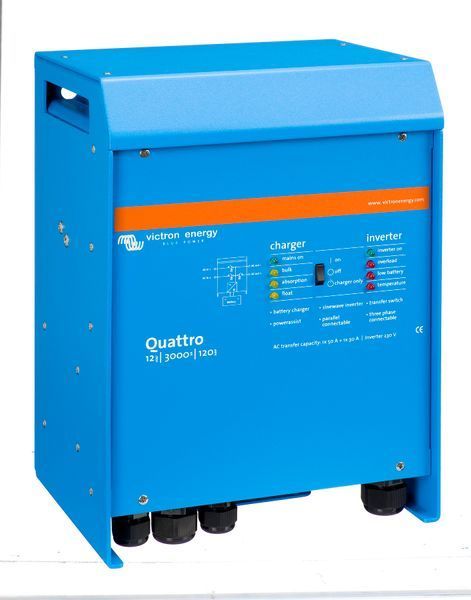
The hybrid inverter Quattro 12/3000/120-50/50 — is the unconditional leader among professional-level voltage converters from the Dutch manufacturer Victron Energy. The device was created for industrial and critical applications: it provides a stable power of up to 3,000 VA, has a powerful built-in 120 A charger, two completely independent alternating current inputs, and also ensures full-fledged operation in both autonomous and hybrid and grid-tied energy storage systems (ESS).
This model takes a central place in energy projects where exceptional reliability, guaranteed uninterruptible power supply, the possibility of future system expansion, and absolutely safe integration with lithium iron phosphate (LiFePO₄) batteries are at the forefront.
The inverter is actively used in the construction of three-phase configurations of three 400V devices (with a capacity of 45kVA/36kW), and also allows the creation of multi-device cascades of 6, 9, and 12 inverters, the total output power of which is 90kVA/72kW, 135kVA/108kW, and 180kVA/144kW respectively.
Key advantages of the Quattro 12/3000/120-50/50 inverter
- Nominal power 3,000 VA / 2,400 W, peak — up to 6,000 W.
- Two completely independent AC inputs with built-in intelligent ATS — provide automatic and instant switching between the city grid and the backup generator.
- Each AC input is equipped with PowerControl and PowerAssist technologies — an ideal solution for scenarios where the generator has less power than the main grid.
- Two alternating current outputs – the AC-1 line is guaranteed to receive power from batteries or PV modules in any situation, and the AC-2 line is engaged only when there is power from an external network, a generator, or a solar inverter.
- Transit power of 50 A (11 kW) – when connected to an external power grid, the inverter passes up to 11 kW through itself, allowing you to freely use any combination of electrical loads without risking overloading the inverter's power circuits.
- High efficiency up to 93%, providing stable and economical operation even under significant loads for a long time.
- Ideal sine wave at the output — any, including highly sensitive electronics, is powered by pure alternating current without the slightest distortion or compromise.
- Built-in charger with a capacity of 120 A — compatible with all common types of 12-volt batteries, voltage regulation range — from 9.5 to 17 Volts. Charge algorithms are perfectly optimized for LiFePO4 batteries with 15 and 16 cells in an assembly.
- Built-in support for LiFePO₄ batteries with data transmission via VE.Bus or VE.Can — for safe, transparent, and fully controlled integration of lithium batteries into the system.
- Industrial aluminum casing, IP20 protection class, stable operation in conditions from –20 to +60°C.
- System scaling up to 28.8 kW / 36 kVA — by parallel connection of up to 12 devices within a single three-phase installation.
Technological features
Two AC inputs with integrated automatic transfer switch (ATS)
- The Quattro inverter is able to simultaneously receive power from two completely different sources: for example, from the city power grid and a diesel generator, two generators, or two independent power supply lines.
- The choice of priority source is carried out automatically, in accordance with the priority set by the user.
- Switching between sources occurs with amazing speed — in less than 4-20 ms, which is absolutely unnoticeable to connected equipment.
- The inverter acts as a full-fledged intelligent ATS built directly into the device casing — there is no need to purchase and install a separate ATS panel.
- For each of the two inputs, their own maximum current consumption limits are set (PowerControl function).
- PowerAssist technology makes it possible to compensate for a shortage of power from the external network by instantly attracting battery energy.
Ideal for solar power plants
- Solar generation is the true field of application of the Quattro line. The inverter functions excellently as part of:
- Fully autonomous power plants (off-grid) without connection to the city grid.
- Hybrid ESS systems working together with MPPT charge controllers or grid-tied PV inverters.
- Systems with a priority mode for self-consumption of solar energy in real-time.
- Thanks to the VE.Bus protocol, the device is easily programmed via the Cerbo GX controller or the VE.Configure application and easily adapts to the characteristics of any photovoltaic system.
Professional ESS logic
The following modes and functions are supported:
- priority self-consumption of generated solar energy.
- automatic backup to protect critical loads in the event of a grid failure.
- smart tariff optimization: charging the battery at a cheap night tariff with subsequent use of the accumulated energy during the expensive daytime.
- setting up non-standard and complex operating scenarios via the Victron Assistants function or the VRM platform.
LiFePO₄ support – data exchange from BMS
The Quattro 12/3000/120-50/50 inverter was designed with a view to joint operation with modern lithium batteries (LiFePO₄). Communication with the battery management system (BMS) via VE.Bus, VE.Can, or BMS-Can buses provides the following capabilities:
- Intelligent control of battery charge and discharge currents and modes.
- Multi-stage protection against overheating, overcharging, and critical overvoltage.
- Accurate and continuous monitoring of the state of charge (SOC) and the temperature regime of each cell.
- The maximum possible operational safety and a significant increase in the service life of expensive battery cells.
Use cases
- Industrial facilities – where high power and continuity of production processes are critically important.
- Business centers, medical institutions – for reliable backup power supply of critical zones.
- Large hybrid and fully autonomous solar power plants.
- Private estates with a high level of power consumption – for stable and uninterrupted energy supply.
- Mobile service complexes and container power installations – reliability where there is no infrastructure.
- Telecommunications facilities and data centers – uninterruptible power supply for IT infrastructure.
Has the ECE R10-5 (EMC) electromagnetic compatibility standard
ECE R10-5 – is an international standard for electromagnetic compatibility (EMC) governing the requirements for electronic equipment installed on vehicles. This document standardizes the permissible level of electromagnetic interference emitted by the device, as well as its resistance to external electromagnetic fields.
What does the ECE R10-5 certificate mean for Victron Energy inverters?
Low level of electromagnetic radiation
- Victron inverters do not generate radio frequency interference that could disrupt the operation of radio communications, GPS signals, mobile networks, or other electronic systems of a car, yacht, or industrial equipment.
High resistance to electromagnetic interference
- The inverters remain fully operational even in the most difficult conditions where sharp voltage surges or strong electromagnetic fields are possible (for example, in the cabins of trucks, buses, construction machinery).
Safe integration into transport systems
- Compliance with the requirements of the UN Economic Commission for Europe (UNECE/ECE) gives the full right to install inverters in cars, campers, marine vessels, and any other transport without the slightest risk of negative influence on the standard electronics, including engine control units and safety systems (like ABS).
Guarantee of quality and compliance with international standards
- The presence of the ECE R10-5 certificate confirms that Victron Energy products have passed strict tests and fully comply with international safety requirements for use on vehicles.
What does this give users of Inverter Smart inverters?
- Lawful use of the equipment in vehicles without the need to obtain any additional certificates.
- Full compatibility with other onboard electronic systems – the inverter does not interfere with radio communication, navigation systems, autopilot, GPS, and any other electrical devices.
- Reliable and stable operation under extreme operating conditions – on marine vessels, caravans, commercial vehicles, and special equipment.
- Protection from the effects of electromagnetic interference – the inverter does not fail during sharp voltage fluctuations in the onboard network.
Communication interfaces
- VE.Bus – used to organize parallel and three-phase operation of inverters, their communication with GX controllers, and deep configuration of all system parameters.
- USB/RS232 (via MK3-USB) – for detailed configuration of the inverter from a personal computer via VE.Configure or VictronConnect programs.
- VE.Bus Smart Dongle – wireless monitoring of the system status and management via the Bluetooth protocol.
- GX Controller – significantly expands the functionality of the inverter. Thanks to the presence of VE.Can, VE.Direct, Ethernet, Bluetooth, WiFi, and USB ports, the controller connects the entire energy system to the internet and the VRM cloud service, which allows connecting MPPT charge controllers, measuring shunts, as well as LiFePO4 batteries with integrated BMS into a single network. All this equipment can be easily and conveniently managed, its parameters monitored, and settings changed directly from a smartphone from anywhere in the world.