

|
Quantity
|
Total
|
||
|
|
|||
|
|
|||
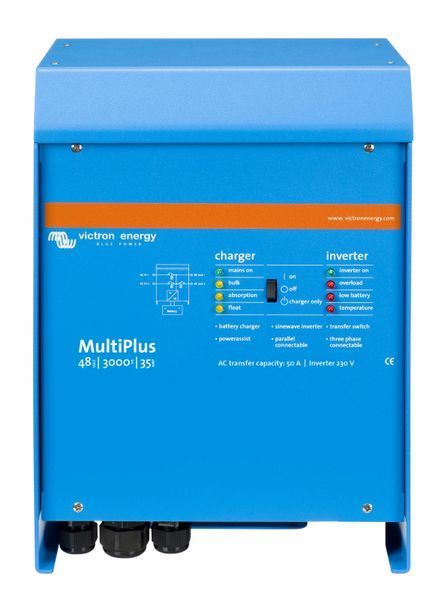
The hybrid inverter MultiPlus 48/3000/35-16 — is a highly efficient inverter-charger from Victron Energy, combining three independent systems in a single compact housing: a high-performance 3000 VA (2400 W) sine wave inverter, an integrated 48 V charger at 35 A, and an automatic source transfer switch with full support for intelligent energy management systems (ESS).
The device is designed for use in autonomous, backup, grid, and hybrid power supply systems. A 48-volt DC bus reduces currents in wires and increases the overall efficiency of the system, especially when working with modern high-capacity lithium batteries. The device is easily scaled: parallel configurations provide up to 30 kVA, and three-phase — up to 90 kVA.
Thanks to PowerControl and PowerAssist technologies, the hybrid inverter MultiPlus 48/3000/35-16 is the optimal choice for solar power plants, emergency backup systems, autonomous power supply for housing, commercial facilities, and transport.
Key advantages of the MultiPlus inverter
The vast majority of the technical characteristics of this device are ahead of the offers of competing European brands and significantly surpass the parameters of budget Asian analogues.
- Power – nominal: 3000 VA / 2400 W, peak: 6000 W — confident start of loads with high starting currents: pumps, compressors, industrial power tools.
- True 230 V sine wave – flawless and absolutely safe power for all types of sensitive consumers.
- High efficiency up to 95% — one of the best indicators in its class. Highly efficient conversion with minimal heat loss and insignificant heating even during continuous operation under full load.
- Economical standby mode – up to 12 W in Search Mode — without load, the inverter goes into sleep mode, reducing battery consumption to a minimum.
- Wide operating input voltage range 38–66 V – optimized for LiFePO4 48 V batteries. The charging algorithm and inverter parameters are simultaneously easy to configure for almost all common types of both lithium and lead-acid batteries.
- Operability at temperatures from -40 to +65°C – the device fully maintains its performance in any climatic conditions: from arctic frosts to tropical heat. Installation is allowed in onboard systems of cars and yachts, in outdoor telecommunication cabinets, and unheated rooms.
- Compatibility with generators of all types – gasoline, diesel, inverter, and gas units. A wide range of built-in tuning parameters provides optimal joint operation with any generator. A function for automatically controlling the start and stop of a generator based on the specified conditions of the battery charge is implemented.
- Expandable ecosystem of options and additions — opens up possibilities for remote monitoring, remote control, reprogramming, and firmware updates via the internet.
- VRM cloud platform — full control over the energy system at any time. Configure personalized PUSH notifications about network failure, battery level drop, auto-starting the generator, and other events — any of them can trigger an automated scenario.
Technological features
1. Two independent alternating current outputs
The first output – priority, uninterrupted: instantly provides power to all critical loads upon loss of external power, switching to batteries without any delays.
The second output – auxiliary: works exclusively in the presence of power from the city grid or generator. Ideal for secondary loads (boilers, charging stations) that must not discharge the battery during an emergency.
2. PowerControl – smart balancing of grid consumption
The system administrator sets the limit value for the current consumed from the external grid or generator. The inverter continuously manages the distribution of available power in real time: powering loads — is a priority, charging batteries — from the remaining reserve, without exceeding the set limit.
3. PowerAssist – prompt boosting at peak loads
At the moment of a sharp consumption jump that the generator or city grid cannot cope with, the inverter immediately brings the battery into operation as an additional power source. After the peak subsides, the system ordinarily resumes charging the battery.
4. Full integration with solar systems
MultiPlus successfully functions in both hybrid and fully autonomous (off-grid) photovoltaic installations. Seamless joint operation with Victron MPPT controllers and grid PV inverters is supported in modes of self-consumption, emergency backup, and autonomous operation without the grid.
5. Remote monitoring and control
Connecting the inverter to Cerbo GX or Ekrano GX system controllers (or via the VE.Bus Smart Dongle wireless module via Bluetooth) provides full remote access to system control and viewing its parameters via the VRM cloud portal from anywhere in the world.
6. Remote configuration of all parameters
Using the VRM platform or by directly connecting a personal computer through the MK3-USB adapter, you can change any parameter of the inverter at any convenient time: threshold voltages, operating modes, current limits, programmable relay logic, and other settings.
7. Parallel and three-phase systems
It is possible to parallel connect up to 6 inverters into a single powerful single-phase system, as well as build a three-phase configuration from 3 inverters with support for parallel operation of several devices in each phase. This is an ideal solution for industrial facilities and autonomous mini-power plants.
Use cases
- Autonomous and backup power supply for private houses and cottages
- Office buildings and commercial facilities — backup and tariff consumption optimization
- Farms and agro-industrial facilities — power supply for pumping, ventilation, and refrigeration equipment
- Yachts and boats, campers, motorhomes – complete energy independence on any journey
- Production enterprises and workshops – powerful stable power supply for industrial machines and equipment
- Hybrid solar power plants (ESS) – deep integration with PV inverters and battery energy storage systems
- Backup power for critical infrastructure (security systems, fire alarms, telecommunications, IT server rooms)
Has the ECE R10-4 (EMC) electromagnetic compatibility standard
ECE R10-4 – is an international electromagnetic compatibility (EMC) standard defining requirements for electronic equipment installed on vehicles. The document normalizes the maximum allowable levels of radiated interference and sets requirements for the device's immunity to external electromagnetic influences.
What does the ECE R10-4 certificate mean for Victron Energy inverters?
Low level of electromagnetic radiation
– Victron inverters do not create radio frequency interference that could disrupt the operation of radio communications, GPS, mobile networks, or other electronic systems of a car, yacht, or industrial equipment.
High resistance to electromagnetic interference
– Inverters maintain stable operability in conditions of exposure to powerful electromagnetic fields and sharp voltage surges characteristic of freight, construction, and agricultural transport.
Safe integration into vehicle onboard systems
– Compliance with UNECE (ECE) standards ensures the legal right to install inverters in passenger cars, campers, marine vessels, and other transport without the risk of affecting the operation of the standard control unit, ABS system, or other electronic safety systems.
Confirmed quality and compliance with international standards
– The ECE R10-4 certificate confirms that Victron Energy products have passed all necessary tests and fully comply with international safety requirements for use in transport.
What does this give users of Inverter Smart inverters?
- Legal operation of equipment in vehicles without additional certification.
- Electromagnetic compatibility with all onboard systems – without interference for radio, navigation, autopilot, GPS, and other electrical appliances.
- Reliable operation in difficult conditions – marine vessels, residential trailers, commercial and special vehicles.
- Protection from electromagnetic interference – the inverter is resistant to sharp voltage changes in the vehicle's electrical network.
Communication interfaces
-
VE.Bus port – for parallel/three-phase operation, configuration, and communication with GX controllers for internet connectivity.
-
Programmable relay – allows you to automate necessary processes.
-
Optional Bluetooth – use the VE.Bus Smart dongle to control the inverter directly from your smartphone via the state-of-the-art VictronConnect app.
-
Optional USB Type A or Type C – connect the inverter to a PC using the Interface MK3-USB cable.
Supports ESS (Energy Saving System)
Victron ESS – a new-generation smart energy system that allows you to:
-
Intelligent source management (grid/generator, battery, solar energy) – priority given to renewable energy.
-
24/7 backup – critical loads are always covered.
-
Self-consumption – minimization of electricity costs.
-
Flexible adaptation to rates – charge at night, discharge during peak hours or according to another convenient schedule.
-
VRM visualization – comprehensive analytics, event log, remote support.
The goal of ESS is to significantly reduce electricity costs and protect consumers from regular or emergency power outages. ESS is optimized for specific user electricity usage scenarios to achieve maximum independence and efficiency in solar energy utilization.
LiFePO₄ support with data exchange – safety and accuracy
The MultiPlus 48/3000/35-16 is fully compatible with lithium batteries, including LiFePO₄ with BMS via VE.Bus and/or VE.Can. Data exchange allows:
- accurately measure SOC (state of charge)
- prevent overcharging or deep discharge, which damages the battery
- automatically limit current or disconnect the load when critical battery parameters are reached
- synchronize the charging profile according to the battery manufacturer’s recommendations.
- log all warnings and critical events in the event log
- maintain the warranty throughout the maximum service life
This is critically important for the safety, service life, and stable operation of batteries in modern power systems.