

|
Quantity
|
Total
|
||
|
|
|||
|
|
|||
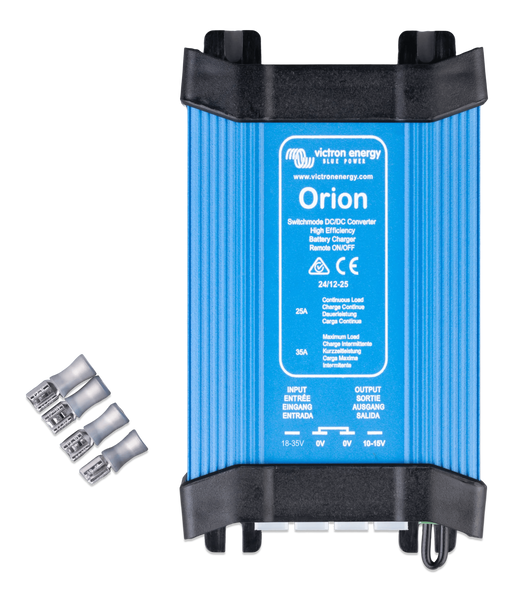
Victron Orion 24/12-30 Step-Down Converter — is a reliable and high-performance DC-DC converter. It solves one of the most common tasks: safely and without surges lowers the voltage of the 24-volt onboard network to clean, stabilized 12 Volts. The device outputs a solid nominal current of 30 Amperes, which is more than enough to power most equipment in commercial transport, mobile laboratories, on yachts, and in solar power systems.
Main Advantages of the Victron Orion 24/12-30 Series
- Real power: continuous current 30 A (up to 360 W)
- Precise stabilization: there is always a steady 12 V at the output (with an error of no more than ±3%), regardless of input fluctuations
- Omnivorous input: stably operates at an input voltage from 18 to 35 Volts
- Industrial connection: powerful screw terminals guarantee excellent contact without voltage loss
- Indestructible format: compact aluminum housing with a passive ventilation system
- Smart self-protection: electronics save from short circuit, overheating, overloads, and even incorrect polarity when connecting
- Unlimited scaling: converters can be connected in parallel if you need to increase the total power (for example, to 60 A or 90 A)
- Remote control: supports turning the device on and off using an external low-current signal (ignition switch, button)
Why Choose This Particular Converter?
Power Reserve for Serious Equipment
The Orion 24/12-30 converter easily pulls:
- Powerful car refrigerators and pumping stations
- Bright LED chandeliers, beams, and searchlights
- Sensitive marine echo sounders, radars, and walkie-talkies
- Communication systems, telemetry, charging stations
- Backup 12V inverters and construction tools
Autonomous Security System
- The device does not burn out in the event of a short circuit
- If the converter overheats (for example, in a hot hold), it does not turn off abruptly, but smoothly reduces power to cool down
- After the emergency is resolved, operation resumes automatically
Thoughtful Ergonomics
- Mount the device however you like: on the wall or on the ceiling
- The anodized housing is not afraid of the vibrations of heavy special equipment or wave impacts
- The terminal block is located in such a way that it is convenient to insert thick wires even in a tight niche
Typical Areas of Use
- Commercial transport (trucks, tractors) — powering 12-volt cigarette lighters, radios, and walkie-talkies from a 24-volt onboard network
- Yachts and boats (24V) — clean 12V power for navigation and echo sounders without background noise
- Roadside assistance vehicles — charging a 12V battery from the main traction alternator
- Repeaters and server rooms — 12V backup power for routers and controllers
- Industrial automation — stable energy for low-voltage automation
International Automotive Standard ECE R10-6 (EMC)
The device is certified according to the strict European standard ECE R10-6. This is a guarantee of the highest electromagnetic compatibility of electronics with transport onboard systems.
What is the Real Benefit of the ECE R10-6 Certificate?
Absolute Radio Silence on the Air
– The device works cleanly. No squeaking or "white noise" in radios, perfect reception of GPS signal and cellular communication.
Armor-Piercing Resistance to External Induction
– The converter does not "glitch" from the operation of an alternator, a powerful starter, or a winch in an adjacent circuit.
100% Compatibility with Standard "Brains"
– The UNECE certificate allows you to legally install this device in any cars and yachts. It will not drive the standard computer (ECU) or the sensors of security systems (ABS, ESP) crazy.
Premium Quality of Components
– The standard confirms that components capable of withstanding vibrations, temperature changes, and humidity for decades were used in the assembly.
Control Options
- External start (Remote ON/OFF) – activate the device with a button on the dashboard, the ignition key, or a smart BMS system.
- Fine calibration – built-in potentiometers (trimmers) allow you to slightly raise the output voltage to compensate for its loss on very long wires.