



|
Quantity
|
Total
|
||
|
|
|||
|
|
|||
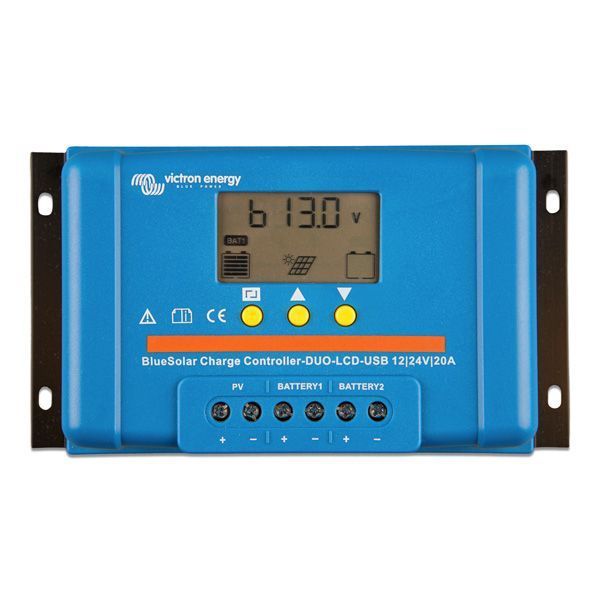
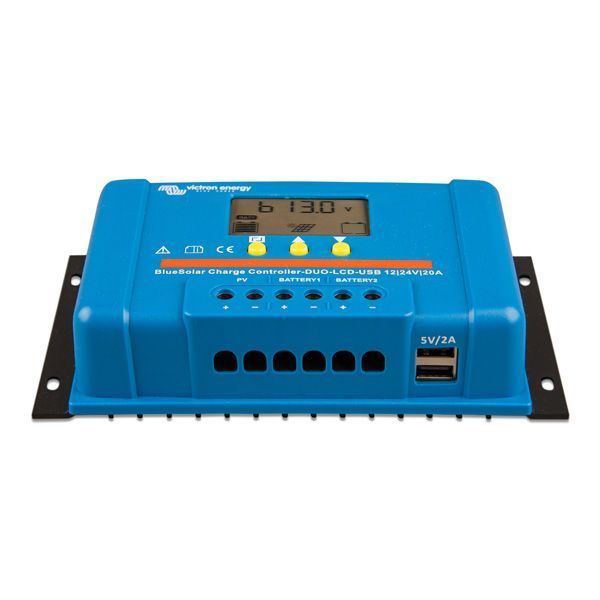
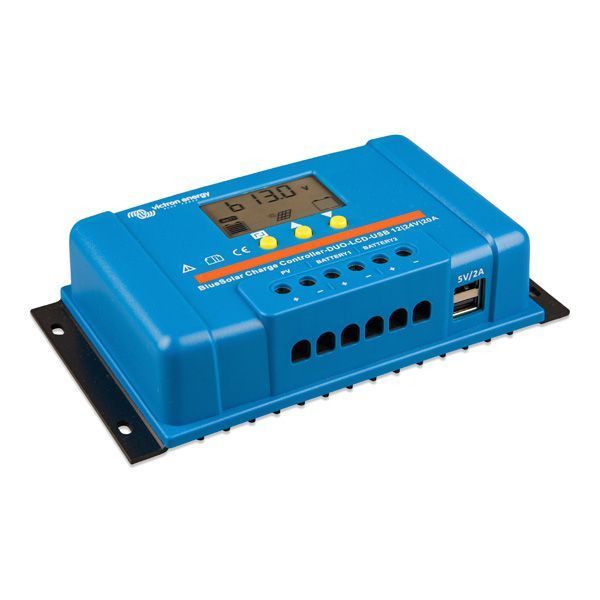
Victron Energy BlueSolar PWM DUO-LCD&USB 12/24V-20A Solar Charge Controller is a specialized, intelligent Pulse Width Modulation (PWM) device engineered for the independent and simultaneous management of two isolated onboard battery banks (such as a domestic/service bank and an engine starter battery). Equipped with an informative built-in liquid crystal display and dual USB charging ports, this model represents an ideal, uncompromising solution for integration into the electrical systems of motorboats, speedboats, yachts, campers, caravans, and motorhomes.
Key Operational Advantages
- Dual-Channel Split Charging (DUO): Efficiently and safely distributes generated solar energy between two completely separate battery groups from a single photovoltaic array.
- Flexible Priority Programming: Allows users to manually configure charge current ratios based on dynamic needs (for instance, allocating 90% of available power to a high-capacity service bank and 10% to sustain the starter battery).
- Smart Automation: Automatically detects the nominal system voltage of either 12V or 24V setups upon initial connection.
- Multifunctional LCD Screen: Provides clear, real-time local monitoring of solar generation parameters, as well as the voltage status and state-of-charge of both battery banks.
- Dual USB Interface: Features two integrated 5V ports (supplying a combined output of up to 2A) for the rapid and safe recharging of mobile gadgets, smartphones, and tablets.
Technical and Structural Features
- Nominal Charge Current: 20A (total combined output for both channels).
- Maximum Solar Array Open-Circuit Voltage: Up to 28V (for 12V configurations) and up to 55V (for 24V configurations).
- Wide Battery Chemistry Compatibility: Features pre-configured charging profiles optimized for Flooded (liquid electrolyte) batteries as well as sealed AGM and GEL blocks.
- Ultra-Low Self-Consumption: In standby mode, the controller draws less than 10mA, preserving precious stored energy.
- Comprehensive Electronic Protection: Built-in automated safeguarding algorithms protect against overcurrent, short circuits, and reverse polarity conditions on both the solar array and battery terminals.
- System Grounding Type: Common positive connection, complying with standard electrical practices for various transportation cabins and chassis.
- Environmental Resilience: Engineered for stable operation across a temperature range of –35°C to +60°C and capable of handling up to 95% relative humidity (non-condensing).
Intelligent Dual-Channel Charge Management
The core advantage of this model lies in its advanced adaptive current distribution logic. The controller's operation is mathematically optimized to guarantee that the starter battery is always topped up and prepared to successfully crank the vehicle's engine.
- User-Friendly Programming: Power allocation ratios can be adjusted in just a few steps through the intuitive built-in display menu.
- Automated Energy Redirection: The moment one of the battery banks reaches a fully charged state, the controller instantaneously redirects 100% of the available solar current to the remaining channel.
Typical Application Scenarios
- Recreational vehicles, motorhomes, campers, and caravans (simultaneously sustaining the deep-cycle living-area battery and the vehicle's automotive starter battery).
- Marine applications: yachts, motorboats, and speedboats (reliably separating the power supply of navigation instruments and cabin lighting from the engine ignition circuit).
- Remote стационарные installations and off-grid solar stations utilizing two electrically isolated groups of energy storage banks.
Monitoring Interfaces and Ergonomics
- Informative LCD Panel: Visually translates metrics like voltage, exact charging current per channel, and current photovoltaic panel activity.
- Two USB Ports (5V / 2A): An integrated convenience feature that eliminates the need for external network adapters to charge portable electronics.
- Simplified Wireless-Free Design (No Bluetooth / VE.Direct): Deliberately avoids wireless transceivers to prioritize maximum hardware reliability, user friendliness, and long-term device self-sufficiency.